Imagine a salesperson flying to Chicago for a meeting next month who asks the AI agent in their browser to handle the ticket. An AI agent is an AI assistant that opens pages, fills in forms and works through a task step by step on its own. They give it their airline account login and password, and their credit card is saved in the browser. Every time the agent reaches the payment step, a window pops up asking for approval, and every time they click yes.
From where they sit, every step of this booking was authorized. The problem is that the airline doesn’t necessarily recognize those approvals.
Your yes doesn’t bind the airline
On November 11, United Airlines issued a press release saying it is restricting third-party AI agents from its booking systems. The restriction covers United’s own website and app, and through changes to its booking, ticketing and distribution policies it reaches travel agencies and fare-comparison sites as well.
United gave three reasons. First, handing account credentials to a personal third-party AI assistant can expose sensitive information. Second, an agent might make purchases you didn’t expect, change your account or spend MileagePlus miles; MileagePlus is United’s frequent-flyer program. Third, automated actions could conflict with rules from the Federal Aviation Administration and the Department of Transportation. The release’s example is check-in, where the traveler personally has to confirm that their bags contain no banned items.
The wording deserves a closer look. United says it will prohibit “unauthorized, third-party personal AI agents or assistants.” The authorization in question is United’s. Nothing in the release says a traveler’s own consent creates an exception. CBS News, the US broadcaster, reported the same day that United fares will still appear on comparison sites such as Kayak and Google Flights, so finding a fare won’t get harder. What is being shut out is the agent completing the purchase and operating your account for you.
The strongest objection: other airlines let agents book
Looking only at United, it is easy to conclude that “airlines are blocking AI,” and then to assume switching carriers solves the problem. The objection is a strong one: agents really do save time, you saw and approved every step, and not every company takes United’s line.
The facts back it up. The tech outlet Engadget reported that Southwest Airlines has launched a plugin that lets people book flights inside ChatGPT, the chat AI made by OpenAI. Delta Air Lines’ website terms of use don’t refuse outright either. They say that if you choose to use or authorize a third-party AI assistant, you do so at your own risk and remain responsible for the instructions, requests and transactions it makes.
At this point the question seems to become “pick an airline that allows it.” Read the rest of Delta’s clause, though, and the conclusion points the other way.
Blocked or allowed, the risk lands on you
After “at your own risk,” Delta’s terms say three more things. Your authorization of an agent does not mean Delta authorizes or endorses it. Delta reserves the right to refuse to recognize, interact with or service any third-party agent. And if anyone brings a claim against Delta because you used an agent, you agree to indemnify Delta.
Side by side, United and Delta are closer than they look. United keeps the agent out. Delta lets it in, but counts everything it does against you and can stop serving it at any time. Neither airline takes responsibility for an agent’s mistakes.
The salesperson’s approvals have the same effect in both cases. They prove that the salesperson was willing, but they don’t make the airline share responsibility. If the agent picks the wrong date, buys a non-refundable fare or spends miles while they aren’t looking, at United they first have to deal with the fact that an agent shouldn’t have completed the booking at all. At Delta, the terms already say it was their own transaction.
One thing matters more than a wrong ticket. To check out for you, an agent needs your login and your payment method, and an account usually holds much more than this one flight: accumulated miles, saved credit cards, a passport number, the details of people you often travel with. Hand over the password and the agent can reach the whole account, not just this order. What to settle before connecting an always-on assistant to your main accounts is covered in more depth in An Always-On AI Assistant Should Learn to Stop Before It Joins Your Main Accounts.
Hand over the steps that don’t need your login
So the line shouldn’t be drawn at whether you use AI. It belongs at whether a step needs your account, your payment method or your points.
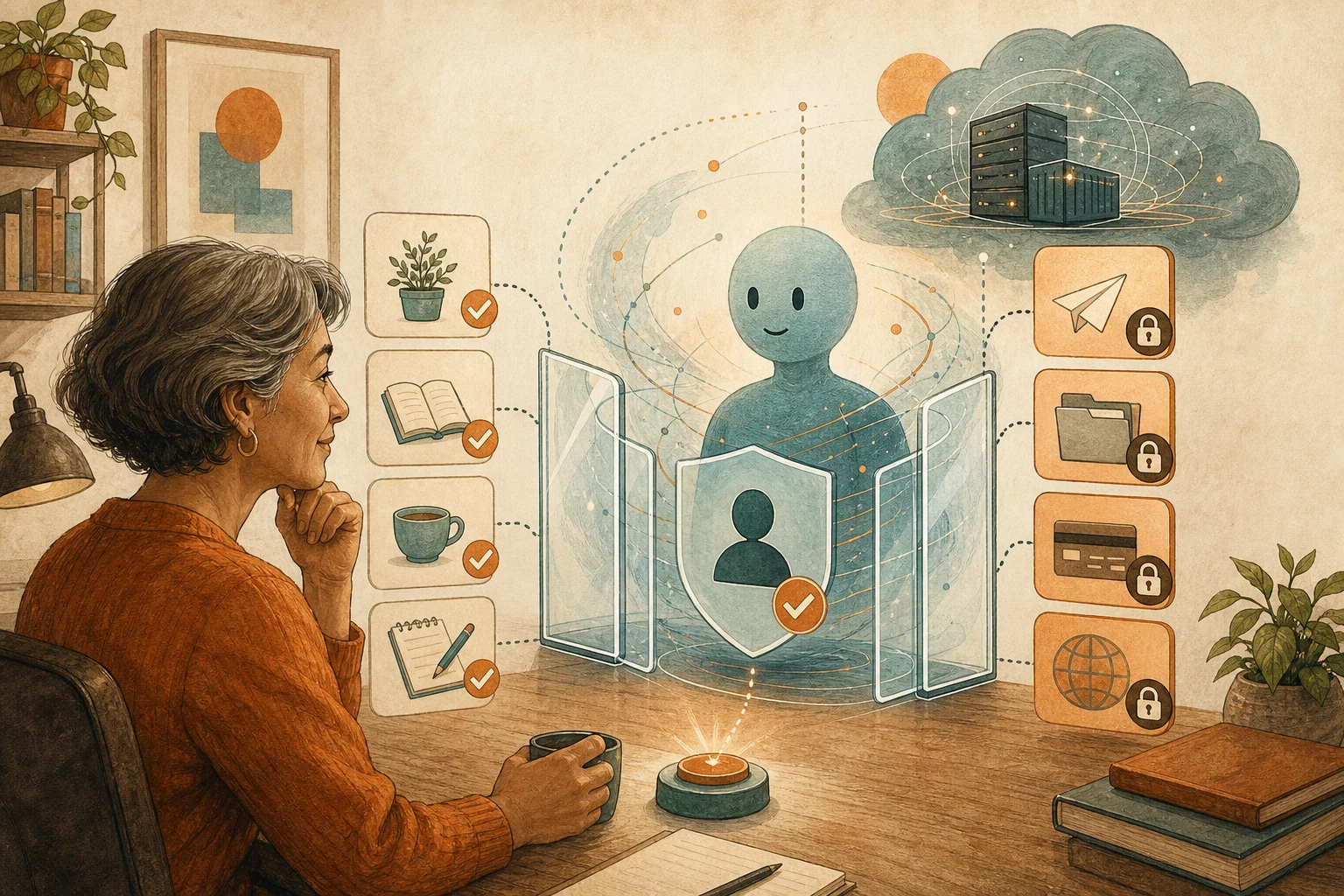
Searching flights, comparing connection times, laying out three candidate itineraries, working out the total with baggage fees: none of this requires signing in, and a mistake costs nothing, so an agent can do it freely. Signed-in tasks such as entering traveler details or choosing seats go to the agent only when the seller’s terms allow it and no card is saved in the browser. Pressing pay, changing or cancelling a booking, redeeming miles and making the declarations at check-in are yours to do.
The exception is an AI channel the seller built itself. Southwest’s integration with ChatGPT is an entry point the airline created and recognizes. That is a different thing from an agent signing in to the airline’s website with your password. In the first case the seller knows an agent is acting at every step and has agreed to accept it. In the second, inside the seller’s systems, the agent looks exactly like you. How a website decides whether to open that kind of entry point is discussed in Does Your Site Need an AI Entry Point? Ask Whether the Job Is Read, Look Up, or Act.
The line isn’t limited to plane tickets, either. The same Engadget report notes that JPMorgan Chase and Amazon also block AI agents for similar security and privacy reasons. Bank transfers, online checkouts and food-delivery orders are judged the same way.
Agent shopping is early, and the terms will change
This judgement has its limits. Agent shopping is still very rare. Engadget cites Uber’s third-quarter earnings call: in the week of Halloween, AI agents brought the ride-hailing company only 500 Uber Eats delivery orders and 4 rides, out of 320 million trips and deliveries that week. The terms were written at that tiny volume and will probably change over the next year or two. United itself says it will keep evaluating how personal AI assistants interact with its services, and will update the Digital Trust Center on its website to explain what the new restrictions mean for travelers, including where to get help if an agent takes an action they didn’t intend.
The other limit is convenience. If you press pay yourself every time, the agent saves you less time. For a small order you can cancel for free, that cost may not be worth paying. But the size of the risk isn’t set only by the price of the order. It also depends on what is inside the account you hand over. With an account that has a credit card attached and tens of thousands of miles stored, even a cheap ticket gives the agent access to the whole account.
Next time an agent is about to check out for you, open that site’s terms of use and search for “agent,” “automated” or “AI.” If you find “at your own risk,” keep the payment step for yourself. If you find “prohibited” or “may cancel,” let the agent go no further than the checkout page. If you find nothing, send customer service one question: when an agent places an order with my account and something goes wrong, how do you handle it?
AI handoff card
I want an AI agent to complete a transaction for me on a website, such as booking a flight, reserving a hotel or shopping online, and I want to decide first which steps I can hand over.
The method comes from this article: https://boosterminiclass.com/en/posts/ai-agent-checkout-needs-the-sellers-consent/
The article's position: my approval only speaks for me. When a seller's terms don't recognize agents, the cost of a mistake lands on me. Steps that don't need my login, payment method or points can go to the agent; paying, changing my account and redeeming points I do myself, unless the seller offers an AI channel it recognizes itself.

First, ask me 3 questions:
1. Which website or app the transaction happens on, and whether I have read the parts of its terms of use about AI, automation or third-party agents;
2. Which logins, saved payment methods, miles or points the agent would need, and what else is stored in my account;
3. Whether the transaction can be cancelled for free, and until when.

Based on my answers, give me:
- A step split: what goes to the agent, what happens after sign-in and so depends on the terms, and what I must click myself;
- The sentences I should look for in the terms, and what each kind of wording means;
- If the terms say nothing, one question I can send straight to customer service;
- Whether this seller might offer an official AI channel, and where I should check;
- A one-line verdict: the agent can go as far as the checkout page / the agent only searches and compares / I do this whole transaction myself.
Judge only from what I tell you. Don't sign in, fill anything in or pay for me; whether to hand anything to an agent is my decision.
References
- United Airlines official press release: United Restricts Access for Third-Party AI Agents — https://united.mediaroom.com/news-releases?item=125496 (2026-11-11)
- Delta Air Lines official website terms: Terms of Use — https://www.delta.com/us/en/legal/terms-of-use [accessed: 2026-11-13]
- Engadget: United is restricting AI agents from booking flights — https://www.engadget.com/2314121/united-is-restricting-ai-agents-from-booking-flights/ (2026-11-11)
- CBS News: United Airlines bans AI agents from booking flights on behalf of travelers — https://www.cbsnews.com/news/united-airlines-bans-ai-agents-booking-flights/ (2026-11-11)